CASE STUDY
Redesigning e-commerce for 74.9M annual visits under regulatory constraint
Systembolaget is Sweden's state-owned alcohol retail monopoly: 448 stores, 74.9 million digital visits per year, and a mandate shaped by public health rather than commercial growth.
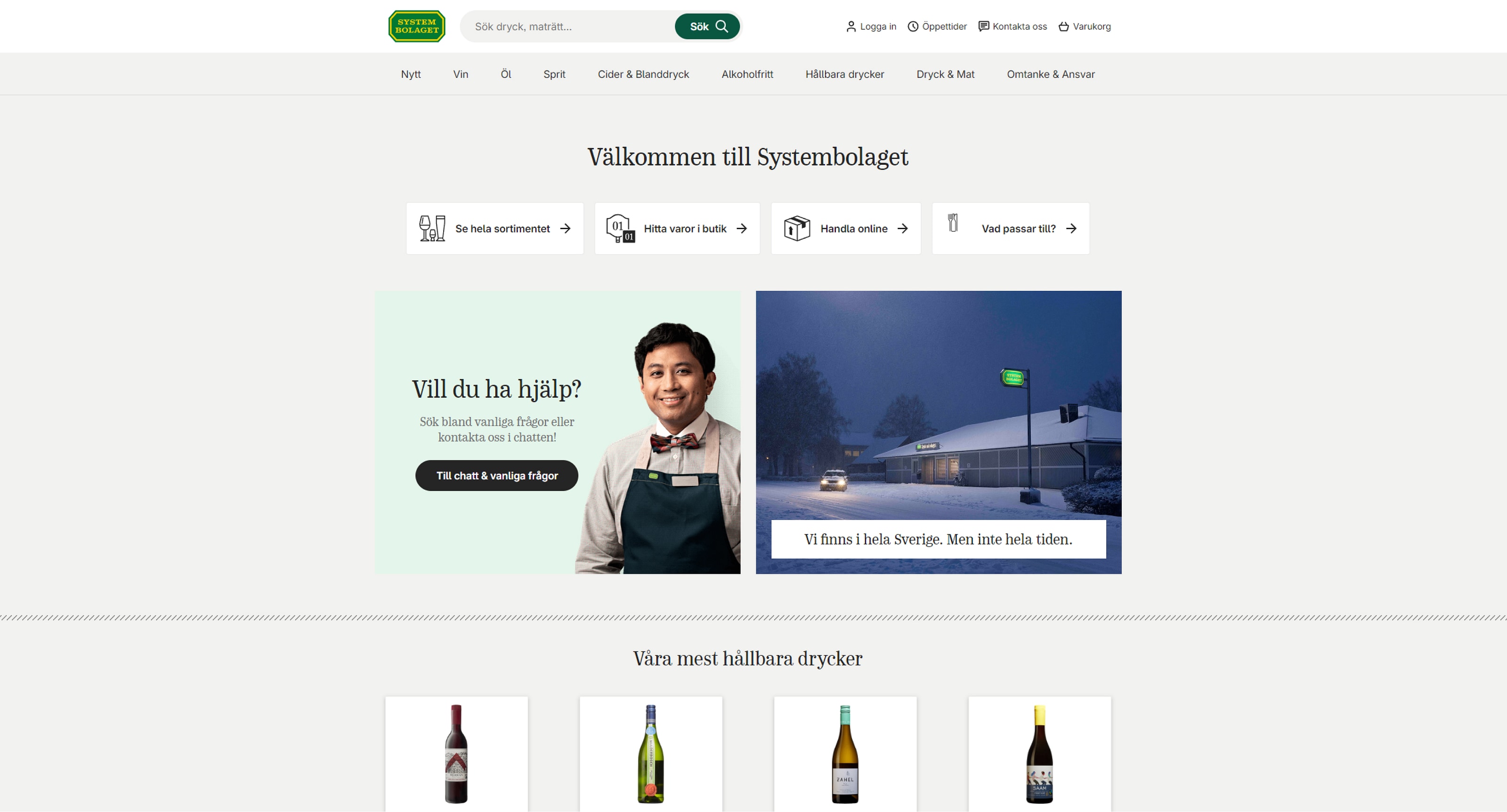
Most digital product work is optimised for conversion. Systembolaget is not. As a state-owned monopoly with a public health mandate, their goal is to provide the best possible customer experience while not increasing alcohol sales or consumption. The legal and ethical framework shapes every design decision, from what you can surface in search results to how product copy is written.
That constraint turned out to be generative. It forced the team to think about customer experience on its own terms: clarity, self-service, education, and trust. Not as a funnel to push people through, but as a system that should leave users better informed than when they arrived.
Beyond the product work, the organisation was running on a 100% waterfall development model, with no cross-functional teams, limited design influence in the process, and decisions made top-down. One of my mandates was to change that.
Project scope
Omni-channel experience
A unified customer experience across web, app, and physical stores: one brand, one interaction model.
Visual identity refresh
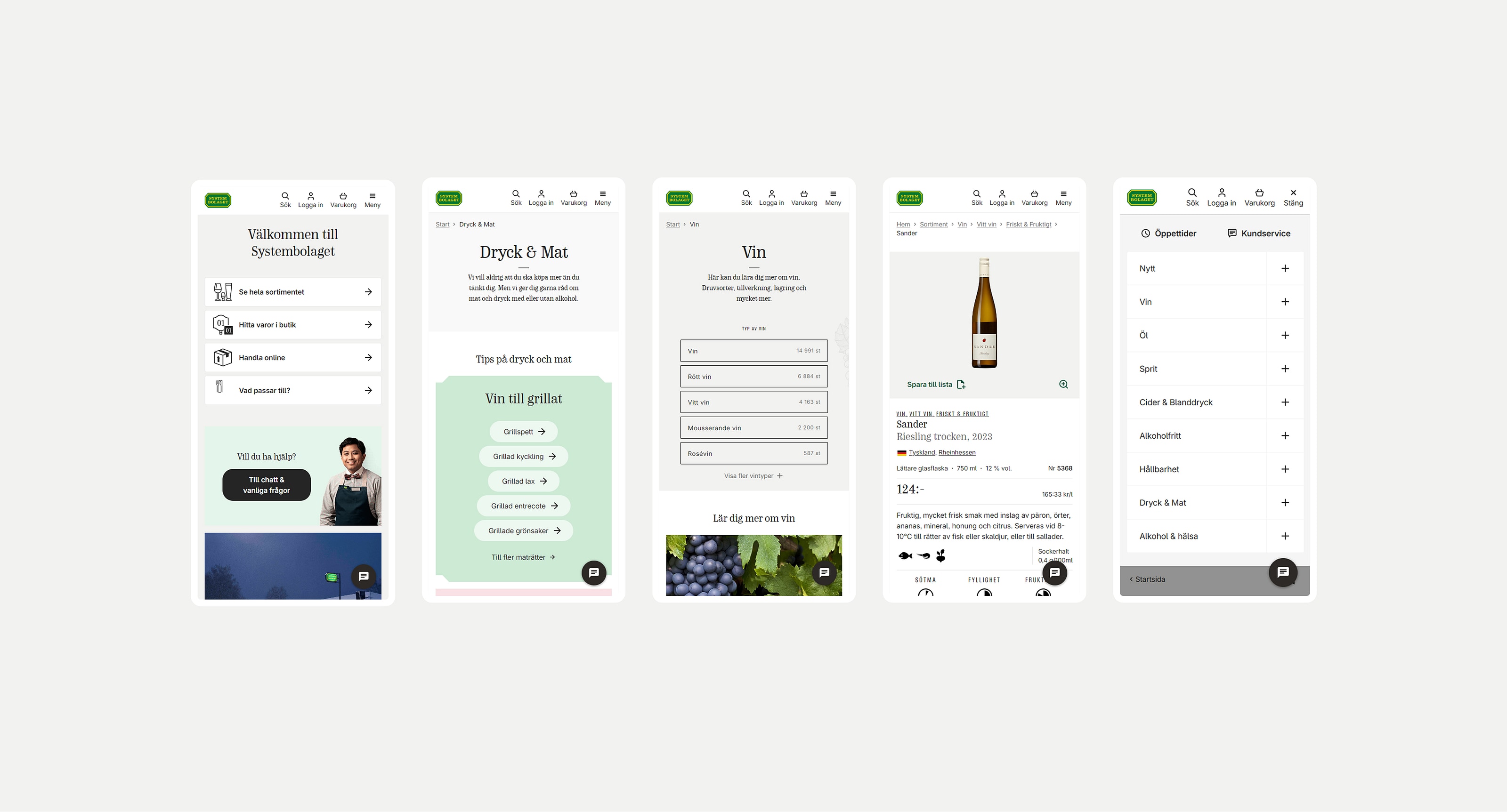
A new design language rolled out consistently across all digital platforms.
Product discovery
Better exposure of the assortment and the knowledge content customers rely on when making decisions.
Customer self-service
Improve findability so customers can help themselves, reducing the need for support at every stage.
E-commerce funnel
Rebuild the full journey from Find through Compare, Decide, Checkout, and Obtain across all channels.
WCAG 2.1 compliance
Full accessibility across all platforms, validated with users across nine disability categories.
Personalisation and relevance
Increase average session depth through smarter recommendations and contextual knowledge content.
My involvement
Information architecture
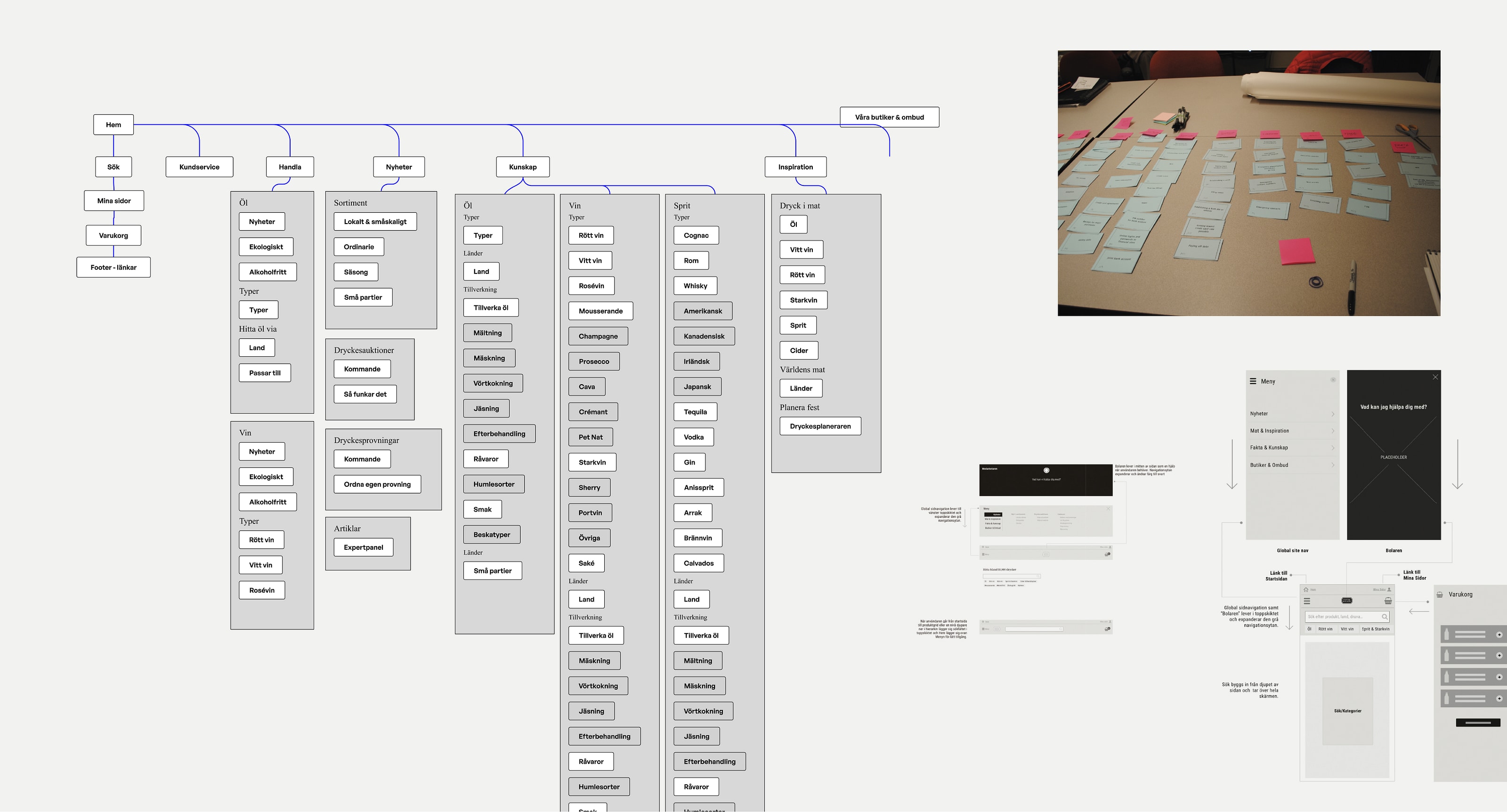
Led card-sorting workshops that restructured the entire content taxonomy across the digital estate.
Navigation systems
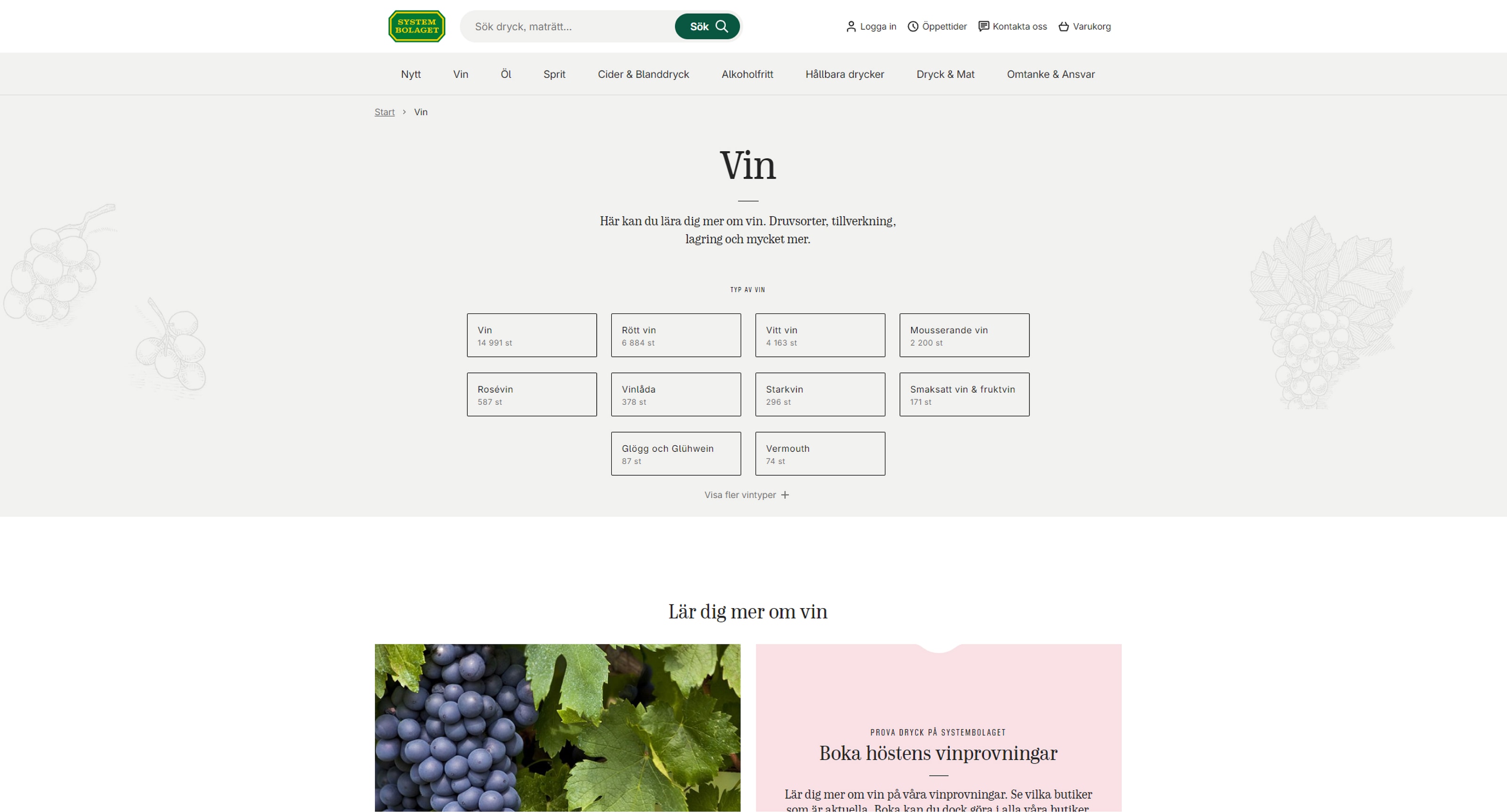
Designed all six navigation patterns: top nav, hamburger (mobile), action menu, breadcrumbs, category filters, and sidebar.
Search, built from scratch
Developed the complete search logic from the ground up: ranking, filtering, autocomplete behaviour, and synonym handling, all within Swedish alcohol regulations.
E-commerce funnel
Owned UX across the full purchase flow: category browsing, product detail, cart, and checkout.
Design system
Co-managed the design system together with colleagues, defining components, patterns, and governance to keep web and app consistent across teams.
A/B testing programme
Owned the experimentation setup, running live A/B tests to validate hypotheses against real traffic before committing to full implementation.
Accessibility leadership
Led all accessibility work end-to-end: partner meetings with external specialists, testing across nine disability categories, and WCAG 2.1 compliance across all platforms.
SEO agency partnerships
Held partner meetings with external SEO agencies, shaping the semantic structure, URL architecture, and measurement instrumentation.
Agile transformation
Initiated and drove a bottom-up agile transformation. Held lectures for top management on agile development and new ways of working.
A year in discovery
Stakeholder interviews across cross-functional teams
We ran structured interviews to surface pain points and competing priorities before bringing in the customer view. Understanding internal tension early saved weeks of re-alignment later.
Usability testing on the existing site
We identified where customers were failing, not where we assumed they were. Session recordings, task completion rates, and observed workarounds gave us a grounded starting point.
Quantitative data at scale
We analysed significant volumes of data across Google Analytics, the BI platform, and the support system, connecting behavioural signals to service failures and ranking problems by actual user impact rather than internal intuition.
Surveys, heatmaps, and card sorts
We collected feedback digitally and through call-centre partners, used heatmaps to understand how customers scanned pages, and ran card-sorting sessions with diverse participants to build the information architecture from real mental models, not inherited organisational logic.
A/B testing on the live site
Where we could validate hypotheses against real traffic before committing to a full redesign, we did.
The e-commerce funnel
Five stages: Find, Compare, Decide, Checkout, Obtain
The brief was to support customer goals at each stage without nudging toward higher consumption — a constraint that made every micro-decision in the funnel a product design problem as much as a business one.
Navigation as the entry point
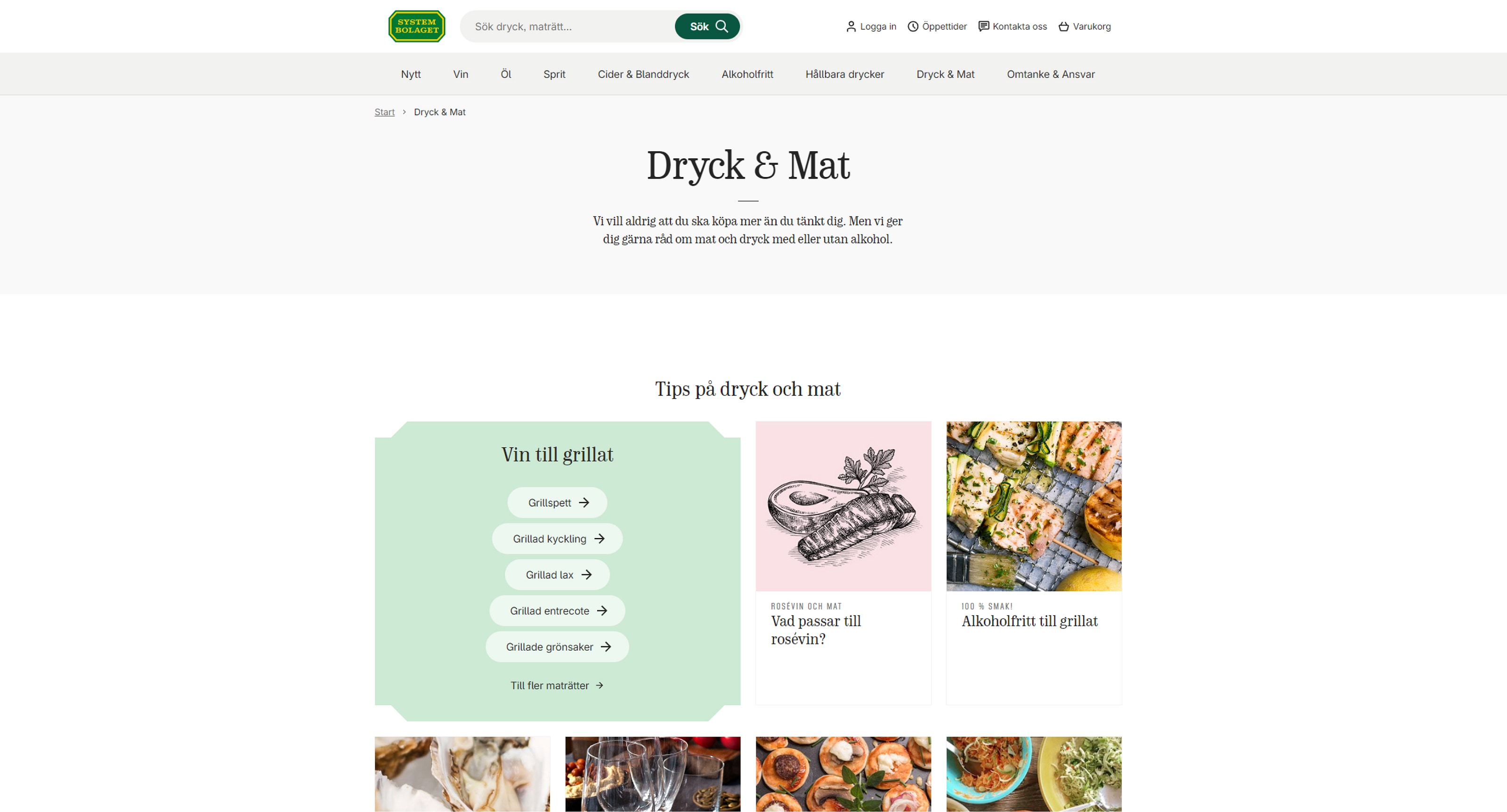
Across six navigation systems we used a mobile-first approach. Wireframes were tested with users before any high-fidelity work began, iterated until we could observe reliable task completion, then taken into visual design.
Eight customer personas as the decision filter
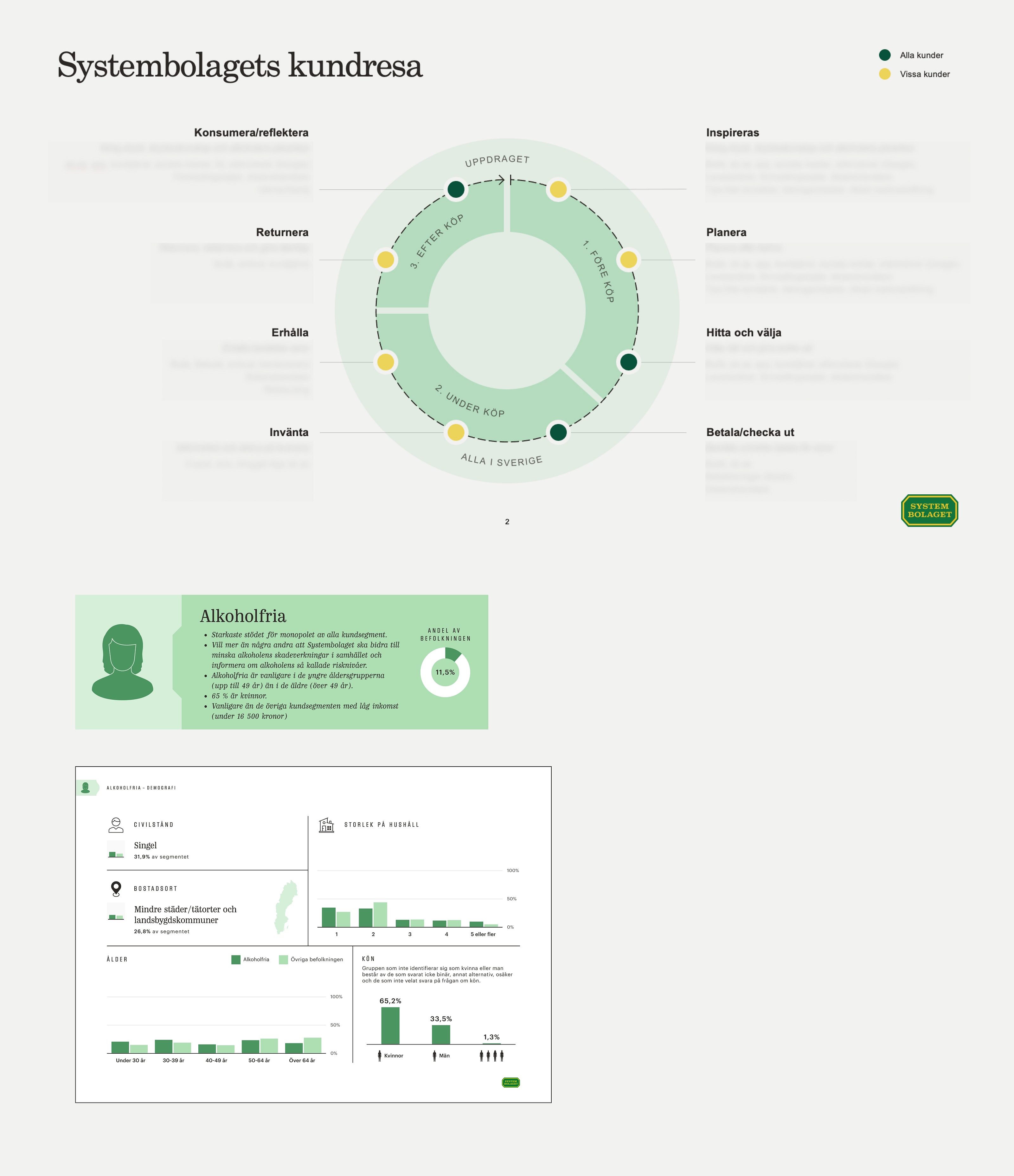
One of the most valuable research outputs was a set of eight distinct customer segments built from interviews, surveys, and behavioural data. Rather than designing for an average user nobody actually is, these personas became the decision filter throughout the project.
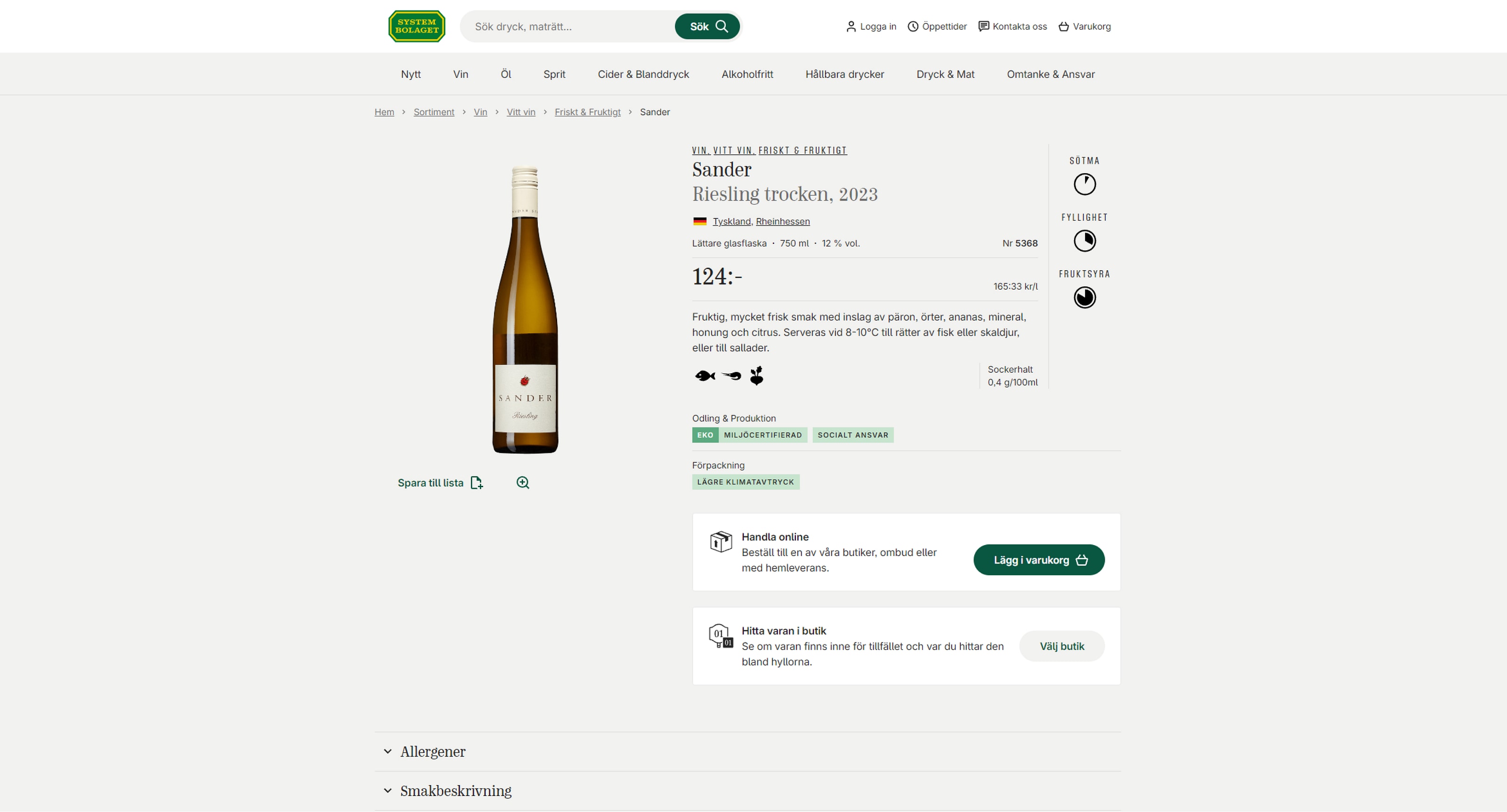
Building search from scratch
Starting from the baseline
The existing search was broken on almost every dimension. I took ownership end-to-end and built the search logic from scratch: relevant results, intuitive entry point, autocomplete, robust handling of misspellings and synonyms, speed, personalisation, and progressive narrowing through filters.
The legal framework complicated everything
Swedish alcohol regulations meant we could not surface product names in autocomplete — too direct a route to purchase. Manufacturer and brand names carried the same restriction. The search experience I wanted to build kept colliding with regulatory guardrails.
Resolution through iteration
The resolution came through iteration with legal, engineering, and external partners. We wireframed scenarios, ran user tests, and progressively refined until we reached a configuration that worked: legally compliant, discoverable, and meaningfully better than what existed before.
Initiating the agile transformation
Waterfall was the most important problem to solve
When I joined, Systembolaget's digital organisation operated on a 100% waterfall model. Requirements were written months in advance. Design happened in isolation from engineering. The feedback loop between a decision and its consequence could take quarters. The waterfall model made it structurally impossible to act on what we were learning from users.
Bottom-up by design
The transformation started with the teams closest to the product, helping them run shorter cycles, ship smaller increments, and create visible feedback loops. As those teams began demonstrating results, I escalated: holding lectures and workshops for top management, making the case for agile in the language of outcomes and risk reduction rather than methodology.
A structural change that outlasted any single feature
By the end of my tenure, Systembolaget had shifted to cross-functional product teams working in sprints, with design embedded in the process rather than upstream of it. That structural change outlasted any single feature I shipped.
What I'd carry forward
Start the transformation before the product work
The agile shift I initiated ran in parallel with the redesign, which meant both efforts competed for time and attention. On a project of this scope, cultural change is infrastructure. Treat it as such.
External partners are force multipliers, not vendors
The SEO and accessibility agencies I partnered with brought domain depth that would have taken months to build internally. Running them as collaborations rather than procurement relationships was a significant factor in the outcome.
A/B testing needs a roadmap, not just a tool
We ran experiments, but reactively — testing hypotheses as they surfaced rather than working from a systematic experimentation plan. On a platform with this traffic volume, a structured testing roadmap tied to the product strategy would have compounded the learning significantly.
Formalise design system ownership earlier
Co-managing the design system worked, but the governance model developed organically rather than intentionally. Establishing clear ownership, contribution processes, and a deprecation policy from the first sprint would have saved significant coordination overhead as the system grew.
Outcomes
All goals met
Every project objective validated and shipped. Beta 2020, full release to all users 2021.
WCAG 2.1
Full accessibility compliance across all platforms, tested with real users across nine disability categories.
74.9M visits
Annual digital visits served by the new platform after launch.
Agile shift
From a 100% waterfall organisation to cross-functional, agile product teams — a structural change, not just a process tweak.
Next case
Driving executive buy-in in a 5-day Lean UX sprint